Burial Archaeology
Introduction
This page presents a survey of burial practices from earliest times to the recent past, with particular emphasis on Britain. Evidence from elsewhere is used for those periods from which there is little surviving in this country. Follow these shortcuts to the period sections: early prehistory, Neolithic, Bronze Age, Iron Age, Roman, early medieval, medieval and later.
Also included are short discussions on the archaeological techniques relevant to burial archaeology, legal aspects of excavating human remains, and interpretation of burial sites. A basic bibliography is included, although there are significantly more recent publications available now and some of the books listed are out of print.
In studying the nature of attitudes to death and related rituals in the past, it is important to remember the alien nature of pre-Christian burial practices, especially prehistoric ones. Whilst we know what people did from the evidence of excavated remains, we can't be sure why they did things in a certain way or about the rituals which were involved.
Note that the dates of periods quoted below are rough - there is considerable overlap, especially in Prehistory.
Palaeolithic
In this period, hunter-gatherers were sometimes living in caves but were also making temporary open-air camps such as found at Boxgrove and on gravel sites in East Anglia. In some areas there were base camps (often caves) and subsidiary camps within two hours' walking distance. Small groups of hunters were possibly moving seasonally and leaving temporary structures which have not survived.
Burial at this time is characterized by single or multiple cave burials, possibly because these sites have survived glaciation, or perhaps indicating a preference for burial in such places.
Middle Palaeolithic (250,000–40,000 years ago)
Neanderthal 'burials' have been found in a few caves, such as Shanidar Cave in Iraq. There is some debate about whether these were deliberate or accidental burials (see Stringer and Gamble 1993, p.158).
Evidence from other parts of Europe suggests an increase in the practice of burial during the Middle Palaeolithic, with approximately 200 skeletons known (this includes Neanderthals and 'early moderns').
Upper Palaeolithic (40,000–10,000 years ago)
Aurignacian burials (c.37,000-30,000 years ago) belong to the early phase of this period in Europe. Examples have been excavated at:
Sungir', Russia - the remains of a man buried with 1500 ivory beads, with partial burning to the bones of his feet, suggesting that he was placed on embers.
Cave of Cavillon, Liguria - a burial wearing a cap of netted whelk shells with a border of deer's teeth, red ochre around the face and a bone awl at the side.
Combe-Capelle, Dordogne - similar rites found at a shelter, where burials were associated with ochre, molluscs, flint tools and possiby food.
Cueva Movin, Spain - two graves with low mounds, one containing the shape of the body, which was decapitated and covered with animal bodies, and buried with a quartzite knife. The sacred character of these mounds survived through later occupations of the cave, as they were not flattened.
Dolni Vestonice, Czechoslovakia - a child burial with a necklace of 27 pierced fox teeth, the skull area covered with red ochre and the whole burial below complete mammoth shoulder blades.
Extant physical remains of late Pleistocene Homo sapiens are extremely scarce in Britain. At Paviland (26,000 BP) on the South coast of the Gower Peninsula, South Wales, an adult male, c.25 years old and 1.7m tall, was excavated in a cave in 1823 by the famous antiquary, William Buckland. The skull, vertebrae and part of the right side were missing. The body was sprinkled with red ochre and was assumed to be an 'Ancient British woman', named the 'Red Lady of Paviland'. It was associated with a mammoth skull, mammoth ivory rods, an ivory bracelet and some small snail shells. Others have been found at Gough's Cave, Cheddar (c.12,000 BP), Kent's Cavern, Torquay, and Cresswell Crags in Derbyshire.
Burial practices across Europe in this period vary considerably, with no particular pattern to the position of the body or orientation of the grave pit. About half are associated with red ochre, sometimes interpreted as the colour of life or perhaps used for its preserving properties. Men women and children were provided with tools and weapons, usually near the head, in the hand or close to the body where a pocket or pouch may have been. Shell, tooth and ivory ornaments are very common, many of which may have been sewn to garments which have not survived.
Mesolithic (10,000–6000 years ago)
At this period, there was still a hunter-gatherer culture, but a change in technology can be seen in the archaeological record. A different tool kit was now in use compared with that of the later Palaeolithic. For example, the bow and arrow were increasingly used. This is related to a change in the environment to a more temperate climate with increased woodland and disappearance of large grazing herds. Increases in the exploitation of aquatic resources and small game are also evident. Seasonal camp sites such as Star Carr (NE England) and Kelling Heath (Norfolk) have been excavated. Local adaptations to climate can be seen.
Burial in the Mesolithic is characterized by a shift from single or small groups of burials to larger cemeteries in the open.
No British examples of Mesolithic burials have been identified, with one possible exception. A disarticulated burial in a partially burnt logboat found at St. Albans has been dated to c.4,700 BC, so this could be late Mesolithic or Early Neolithic.
In mainland Europe a number of later Mesolithic cemeteries have been identified:
Vedbaek, Denmark (c.6000 years ago) is in an area well known for Mesolithic settlement. Seventeen graves are known, in rectangular or oval pits, most containing single burials but also some multiples. Most burials were extended on their backs. One grave contained a young woman and newborn baby. The woman had c.190 teeth of red deer and wild boar around her head and another fifty tooth pendants around her hips, with several rows of perforated snail shells. The child had a flint blade at the waist and lay on a swan's wing. This could suggest hereditary status, but there are other interpretations.
Padina area, Yugoslavia. Nine sites along the Danube have produced 350 bodies. These were Cro-Magnon people with long skulls, large brow ridges and large jaws, and were heavily muscled skeletons. One example is. Vlasac Level I (7950-7650 years ago), which produced 57 bodies and evidence for malnutrition in younger individuals. The number of child burials was low. Very young children may have been thrown into the Danube, where scattered bones of young children are occasionally found. The average life expectancy was c.26 years, but once into adulthood the average age at death for women was 30-39 and for men 50-59 years. Eight men and two women were over 60. Some had reached a good age despite pathological afflictions. From the nine sites, population density was calculated and suggested that one generation could vary between 66 to 115 people distributed in 8-10 sub-groups on the banks of the Danube.
Zvejnieka, Lithuania (7500-5000 years ago) produced c.60 graves of Mesolithic date, although the cemetery continued into the Neolithic. There were several multiple graves, for example one containing two adults and three children with grave goods of grooved teeth pendants and ochre, bone daggers and boar's tusks. Again, there were richly endowed child burials, perhaps reflecting hereditary status. Two physical types were identified: long-headed with protruding noses, and round-headed with flat faces.
Burial practices in this period, although in open air flat cemeteries rather than caves, seem to continue the later Palaeolithic traditions of burial with the apparent importance of red ochre, ornaments of shell and teeth, and provision of tools and food. Does this mean that spiritual traditions also remained unchanged despite a change of lifestyle?
Early prehistoric burial practices
Later Neolithic (5500-4700 years ago)
There was a change in burial practices in Yorkshire and other areas around this time. Collective burial continued, but the bodies were undisturbed after burial and survive as intact articulated crouched skeletons. There was also an increase in the use of cremation. Both types were buried under mounds, for example Duggleby Howe.
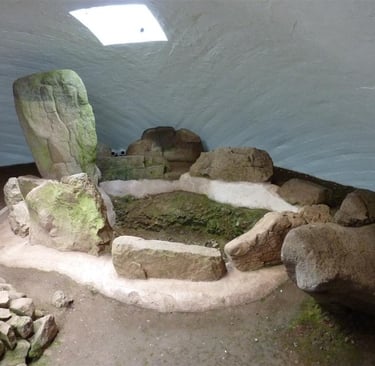
Megalithic passage graves were constructed in Ireland, North Wales and northern and western Scotland. The most famous, from each of these regions respectively, are Newgrange, Bryn Celli Ddu and Maes Howe. Groups of tombs were located in prominent and hilltop situations. They consist of chambers at the end of stone-lined passages with corbelled roofs, covered with large round mounds or stone cairns, c.15-80m diameter. Some Scottish examples have stalls rather than chambers, e.g. Mid Howe, and some of these were even double-decked.
The chambers contain stone basins to hold cremation burials, with unburnt grave goods including small decorated pottery bowls, large bone pins and barrel-shaped stone beads. Occasionally inhumations are buried instead. Mural art is a common feature, usually pecked-out curvilinear or geometric patterns, sometimes deliberately hidden.
Maes Howe in Orkney has a dry stone passage and corbelled chamber. The original burials and grave goods were lost. A runic inscription records the robbing of the tomb by Vikings in c.1150 and describes the discovery of treasure. Neolithic houses in Orkney show similarities to the tomb, with passages into central area with chambers or recesses for beds - i.e. resting places of the dead like sleeping areas. At Skara Brae, the settlement contained the burials of two women in a house which was set apart from the rest and may have been a confinement place for women during menstruation.
Astronomical features are often present. For example, a box is situated above the Newgrange entrance for admitting light from mid-winter sunrise, and the Maes Howe passage faced the mid-winter sunset. A possible communal hall at the nearby village of Barnhouse faced the mid-summer sunset, suggesting that this time of year was concerned with the living, whilst the winter solstice concerned the dead.
Megalithic tombs were also constructed in the South of Britain. For example, Wayland's Smithy, Wiltshire, was altered from an earthen long barrow to incorporate a megalithic tomb.
Other forms of tomb and burial are known. The Dwarfie Stane in Orkney is the only rock-cut tomb in Britain. Ring cairns with a central open area, larger than passage graves and with central burials in pits, are found at the north-east end of the Great Glen. The small henge which was to become Stonehenge was later used as a small cremation cemetery and many burials contained special items such as boars' tusks, thin flint axes, polished flint tools, fine pottery bottles, bone pins and necklaces. At least one example of a bog body, from Hartlepool submerged forest, dates to this period. In Suffolk, excavations at Flixton ring ditch have produced a number of cremations and late Neolithic grooved ware pottery, suggesting that this round barrow dates to the Late Neolithic/Early Bronze Age transition.
Neolithic human remains
The human remains recovered from the Neolithic clearly do not represent the entire population of Britain during that period. During both the early and the later phases it is clear that there is some selection of individuals for particular forms of burial. In the earlier Neolithic this may be based on the appropriateness of the individual for inclusion in communal ritual practices, or on the basis of age and gender, with the whole community contributing to the building of the monuments. Later, the building of megalithic tombs and other monuments shows great advances in architectural and technological terms, and the commemoration of great ancestors suggests that wealth or status may have been the deciding factor. The vast majority of the population has disappeared, perhaps as a result of later destruction or lack of discovery, but more likely as a result of excarnation and scattering of their bones. Perhaps the people buried in the early tombs are merely those whose bones were able to withstand exposure and remained to be collected for burial.
Early Neolithic (6000–5200 years ago)
Large collective monuments for the dead began to appear on the coastal fringes of Western Europe (including most of Britain) at this period. In inland Europe the Mesolithic tradition of burial in simple earth graves continued.
The areas in which these large monuments were constructed correspond with the densely populated regions of the Mesolithic and may have been built as markers of territory between the new and old populations. They represented a permanent link between the community, the ancestral dead, and the land which they occupied, generally being placed close to settled areas in dominant positions. A good example is the West Kennet long barrow (Wiltshire) which dominates the skyline.
There is some suggestion that the shape of tombs is related to the type of housing favoured in an area (round, rectangular, trapezoid or irregular). Houses of the dead were usually more permanent than those of the living, because the ancestors represent the community and the tombs were shrines to these supernatural beings.
Styles varied between regions:
On the chalklands and lowlands of southern and eastern England, long mounds were often piled up on wooden structures. This type is concentrated in Wessex and is often close to another type of ritual monument, the causewayed enclosure. Tombs are usually positioned on uplands and at heads of valleys, perhaps above valley settlements for which no evidence survives. Examples include a very large long barrow at Maiden Castle, Dorset, at one extreme, and a number of long barrows in Norfolk (West Rudham, Harpley, Ditchingham) at the other.
In the Cotswolds-Severn region, internal stone-built chambers are located under wedge-shaped mounds faced with local limestone. These are in prominent positions overlooking the Severn Valley to the north, although the settlements were probably to the south on the shallow slopes of the escarpments. For example, West Kennet, Wiltshire, uses limestone brought from the Cotswolds.
In western Britain, dolmens and cromlechs, large stone chambers possibly covered by earth or stone mounds, are the dominant form. A good example is Lanyon Quoit, Cornwall, although this was rebuilt by the Victorians. In Cornwall and the Scilly Isles, Scillonian chamber tombs are thought to belong to this period, although the only radiocarbon dates so far available suggest a Bronze Age date. Neolithic pottery has been found in the Scillonian tomb at Tregiffian (pictured).
In Ireland, court cairns and passage graves were the norm.
Some tombs began as wooden chambers, e.g. Street House, Cleveland, and some began as circular or oval tombs which were remodelled into rectangular forms. Many were of multi-phase construction.
Some recently discovered long barrows have completely lost their mounds, leaving only a pit containing disarticulated human remains, e.g. at Fengate near Peterborough. At Haddenham, Cambridgeshire, shrinking of the peat revealed a long barrow with a sunken wooden burial chamber containing five articulated skeletons.
The tombs may have had several functions aside from that of disposal of the dead, in the same way that a parish church is not simply a burial place. However, the main function which is visible in the archaeological record is the burial of human remains. Generally these tombs contain several bodies, with an average in Wessex of six per tomb. In most cases the bodies are disarticulated and incomplete, with some degree of erosion or animal gnawing, suggesting that the bodies were exposed to the elements before burial. This practice is known as excarnation.
In some cases it seems likely that the first structure on a site was a timber mortuary enclosure which may have been used for exposure. This was later burnt down and covered by a mound, with some charring of the human remains inside. Deliberate complete cremation is rare.
In Wessex, excavation of causewayed enclosures such as Hambledon Hill has shown that these monuments may also have acted as mortuary enclosures. The ditches are filled with feasting debris, particularly bones of cattle, sheep and pigs, broken pottery, and disarticulated human remains. Skulls were placed at the bottom of ditches soon after they were dug, and deposits continued throughout the natural silting of the ditches.
There is some evidence to suggest that bones were removed from tombs to be used in ritual activities. Skulls are common in enclosures, but generally under-represented in tombs. Sorting of bones within the tombs is also common, and it is likely that tombs were periodically cleaned out for reuse. Adult bones are more common in tombs, but there are more children in causewayed enclosures. This could be a result of scattering of smaller remains by animals so that they were not collected for burial.
Burial in a long barrow may have been reserved for individuals of high status, but there are other possibilities. People may have been selected for their relevance to the rituals in which they were being used, such as shamans, transvestites, wise women, people who died in a certain way, had a certain spiritual type, representatives of each family in a group, etc.
Grave goods or display items were sometimes present, for example pottery, shale beads, bone scoops, flint tools and arrowheads.
Not everyone was buried in long barrows. A few isolated flat graves have been found of this date, for example a female with an Abingdon-type bowl at Pangbourne, Dorset. These are sometimes marked by a post, and as similar animal burials have also been found it may be that the post and not the burial was the important feature, possibly as a totem pole. Casual burials are also found in the ditches of causewayed enclosures and in the shafts of flint mines. Over 250 burials are known from caves in Britain, and these consist of a much larger proportion of children than is found in long barrows, perhaps because they are undisturbed.
Neolithic burial practices
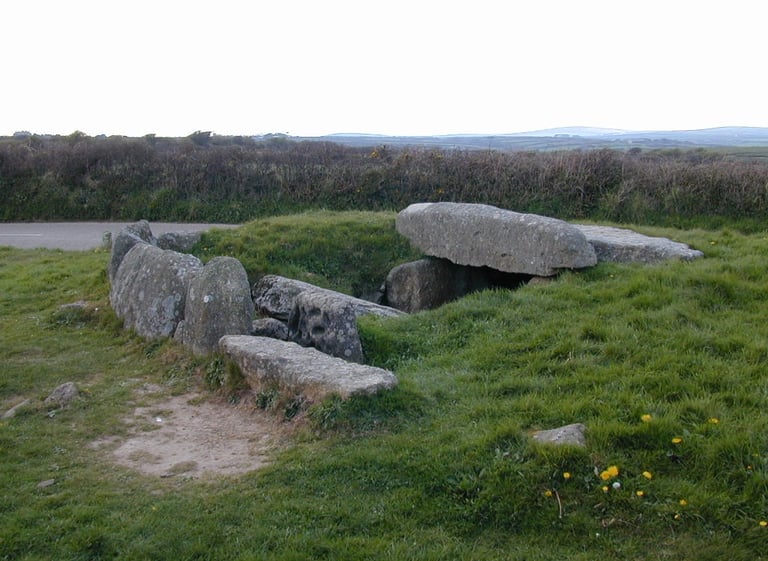
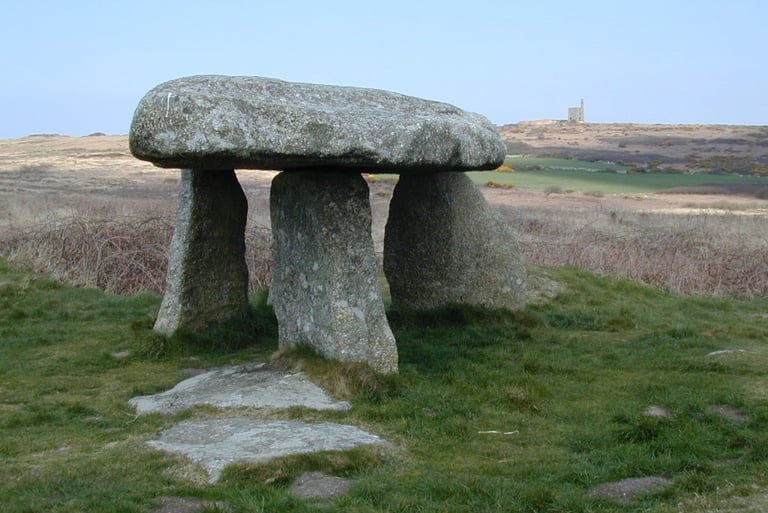
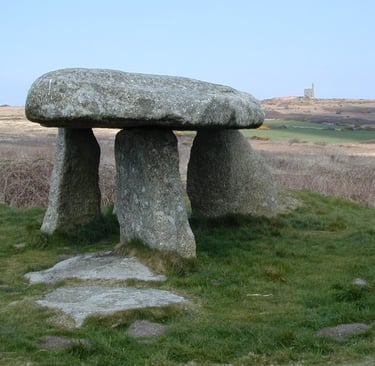
Most excavated remains of this period are ceremonial or funerary in nature. The Neolithic period was a time of change from the old ways of hunting and gathering to a more settled way of life associated with the beginnings of agriculture. Technological changes were also made and are reflected in the material culture. For example, pottery was not made before this period, and flint tools now reflected the need for cereal gathering implements such as sickles. For the first time, permanent structures were built both for the living and the dead. An example of a Neolithic village is preserved at Skara Brae in Orkney.
Burial practices in this period are characterized by collective burial in large, highly visible monuments, and by ritual practices resulting in the scattering of human bones in non-funerary contexts.
Early Bronze Age (c.4700–3700 years ago)
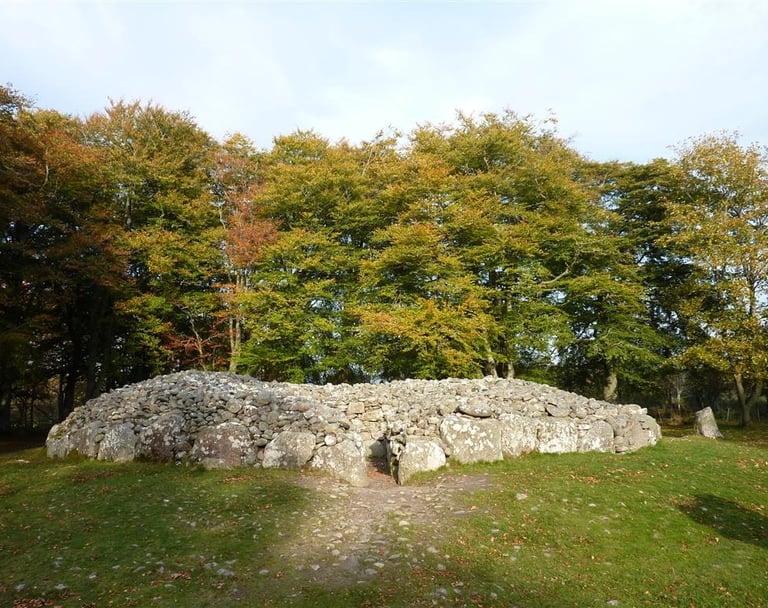
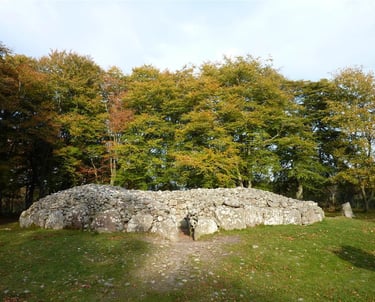
A new form of burial rite, the so-called Beaker burials, began to appear around 4700 years ago. These are crouched inhumations accompanied by a particular pottery form known as a beaker and covered by a small round earthen mound. An example is Shrewton, Wiltshire., dated c.2600 BC.
The people buried in this way generally have broad, rounded skulls in comparison with the Neolithic burials, and they had previously been thought of as invaders. Recent work suggests that the change in head shape could be the result of gradual genetic change within a single population, perhaps related to climate change, particularly in view of the fact that such fluctuations in head shape have been noted at other transitional periods in later history. The introduction of the Beaker culture is probably due to a mixture of migration, trade and copying of new fashions.
The earliest burials of this type were located at some distance from earlier monuments and could represent a new trend away from the henge-building 'establishment', or perhaps at this early stage some really were invaders.
Later, the earlier monuments began to attract cemeteries of round barrows - more than 260 are known within a two-mile radius of Stonehenge (although the stone circle dates to this period anyway). A good example is the barrow cemetery at Winterbourne Stoke, Wiltshire.
Such 'sacred landscapes' are spaced every 6 miles along the eastern river valleys and may mark boundaries or meeting places between territories. They seem to mark the limits of zones of settlements, suggesting different regions for the living and the dead.
Flat cemeteries of beaker burials are also known, especially in Oxfordshire.
At Irthlingborough, Northamptonshire, excavation of one barrow in a group of four revealed a central wooden chamber containing a partially disarticulated male skeleton with a beaker and other grave goods and a second grave pit with another possible male. There was a wooden superstructure over the tomb, which may have been a small shrine or viewing platform. This was covered with a layer of cattle bones over a limestone cairn. The grave goods were derived from Whitby (jet), East Anglia (flint), Wessex (chalk) and the Baltic Sea (amber).
Richer burials are known, e.g. Barnack, which contained gold hair decorations and buttons. However, around 4200 years ago richer burials became common, especially in Wessex. Grave goods indicate continental links of a warrior elite, and there are no more beakers. The richest excavated example is Bush Barrow to the south-west of Stonehenge, which contained a man with a large decorated gold lozenge on his chest, three large bronze daggers, a stone mace, and a gold-decorated baton. Cross-channel connections and exchange of wealth for imported goods suggests powerful and influential local leaders.
Bronze Age burial practices
Middle to Late Bronze Age (4000-2600 years ago)
There were no elaborate burials in Wessex after 3900 years ago for about two centuries, after which similar but less spectacular burials with the same type of grave goods took place. These show links with northern France, the Rhineland and Switzerland, but many items were worn out by the time of burial and may have been heirlooms.
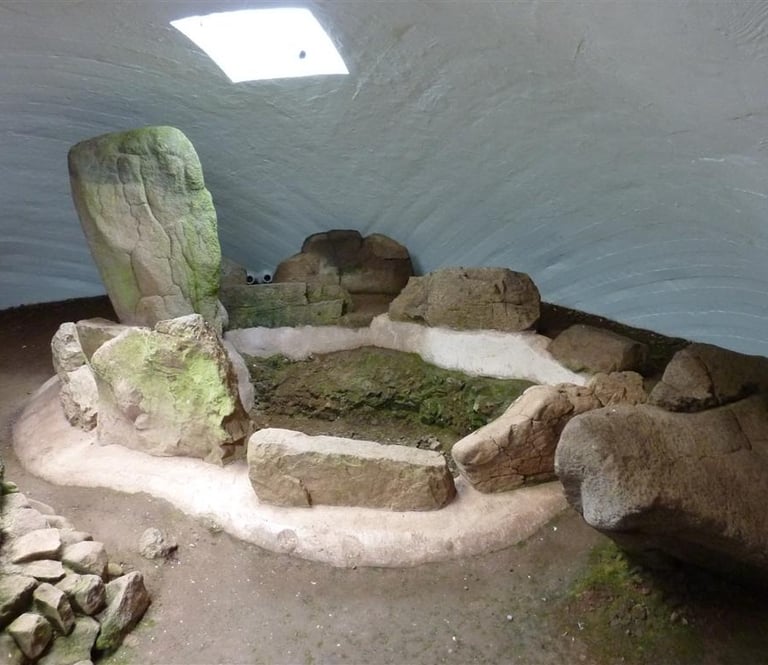
Wessex was in decline at this period and was overtaken by East Anglia. Sacred landscapes were abandoned or reordered. Cremated remains were placed in pottery urns and buried under pre-existing mounds as secondary burials - collared urns are exclusively British and are not found in the rest of Europe. Sometimes they are accompanied by smaller 'food vessel' urns. New mounds or cairns after 3800 years ago were considerably smaller than previously. The archaeological evidence for this period suggests that the dead were no longer at the centre of life - and that the "landscape of the dead was replaced by a landscape of the living".
In the Late Bronze Age the practice of cremation continued, but after 3000 years ago ashes were deposited in shallow pits without a pottery vessel, although they may have been wrapped in perishable materials. By 2800 years ago, cremation had virtually disappeared. Very little is known about the disposal of the dead in this period. A few inhumations with metalwork have been found and some metal hoards contain human bone. Human skulls are found in association with water deposits of weapons in the Thames, perhaps suggesting a move towards sacred water rites with the Thames acting as a British Ganges. Burials in peat and fenland areas are known in East Anglia from this period, especially around Methwold. A few intact skeletons of this period show evidence for violent ends.
Burial in the Bronze Age suggests a continuing change in emphasis towards the individual, with burials of wealthy individuals and children with apparently hereditary status (although their grave goods were presumably supplied by grieving parents and may suggest their status rather than that of the dead child). There may also be a move towards concern with family and personal history rather than the supernatural power of the ancestors, with new beliefs connected with water cults perhaps taking precedence by the end of the period.
The transition between the Late Neolithic and Early Bronze Age is not clearly defined. The use of copper began in the later Neolithic, and flint continued to be used in the Bronze Age for fine weapons such as the newly introduced barbed and tanged arrowhead. Settlements of this period are difficult to identify, perhaps suggesting a transitory lifestyle with sacred areas as meeting places.
The main type of burial at this time consisted of individual interment of firstly crouched inhumation and later cremation burials, often richly endowed with grave goods.
Iron Age burial practices
This period is associated with an increase in the power of tribal chieftains and an age of tribal warfare, with a greater degree of continental influence and the introduction of another new metalworking technology. However, the majority of people probably lived mainly peaceful lives in small dispersed farmsteads.
Burial practices in this period show a continuing tradition of cremation from the late Bronze Age, with later inhumation and richly furnished burials up to the Roman period.
Early Iron Age (c. 2600–2500 years ago)
Like the Late Bronze Age, little is known about the disposal of the dead in this period. Cremation and scattering of the ashes is one possibility, cremation and burial in a pit or under a barrow is another. Crouched inhumations in stone cists of Late Bronze to Late Iron Age date seem to have been the prevalent rite in the south-west peninsula and Wales.
A number of burials have been found in settlement sites such as Gussage All Saints, Dorset, and hillforts such as Danebury and Winklebury in Hampshire. These include skeletons with parts missing, and burials of individual bones, especially skulls, at the bottom of pits in hillforts. There may have been selection of particular bones after exposure for use in ritual prior to burial. But only a small part of the population was involved. Some may have been killed in war, others may have been human sacrifices.
Middle Iron Age (c.2500–2300 years ago)
The Arras culture of Yorkshire consists of large cemeteries with graves under mounds surrounded by rectangular ditched enclosures. These include men, women and children. The culture is an elite burial tradition involving the interment of a two-wheeled vehicle with the body. The burials are generally of men, but at least one woman is known. They are similar to several groups of La Tene burials in Northern Europe, but the crouched position is native to Britain, suggesting emulation of exotic behaviour.
Other types of burial in this period include bog bodies such as Lindow Man, an example of the ritual deposition of bodies in water.
Late Iron Age (2300–1900 years ago)
In this period, inhumations with grave goods are again found. Men usually have swords, shields and sometimes spears, women have mirrors, and sometimes bronze bowls or beads.
There are three main types of burial in the south-east of England:
The Aylesford-Swarling culture in Kent, Essex and Hertfordshire, dated 50 BC-43 AD, consists of urned cremation cemeteries. These include some elite burials with cremated bone in bronze-bound wooden buckets accompanied by vessels associated with wine-drinking and sometimes with amphorae and items of hearth furniture.
Welwyn-type burials are similar, comprising burial of cremated bone in a pit with goods associated with feasting, personal equipment and other items such as gaming sets.
Kingly burials, e.g. the Lexden tumulus in Colchester (c.15-10BC), contained imported luxury goods such as bronze furniture fittings, and iron chain mail with bronze and silver decoration. Most items were partially burnt.
Similar rites with destruction of grave goods are also known in the mid-1st century AD at Colchester and St. Albans. There is evidence to suggest that bodies may have lain in state for some time before cremation.
Rich burials in the post-Caesarian period clustered around the Chilterns and the Essex coast, close to major routes. This indicates that native hierarchies and their systems of elite display survived the invasion.
Early Roman (1900–1700 years ago)
In the early phase, there is continuation of cremation as the main burial rite in East Anglia, with more widespread adoption elsewhere. Some isolated inhumations of this date have also been found.
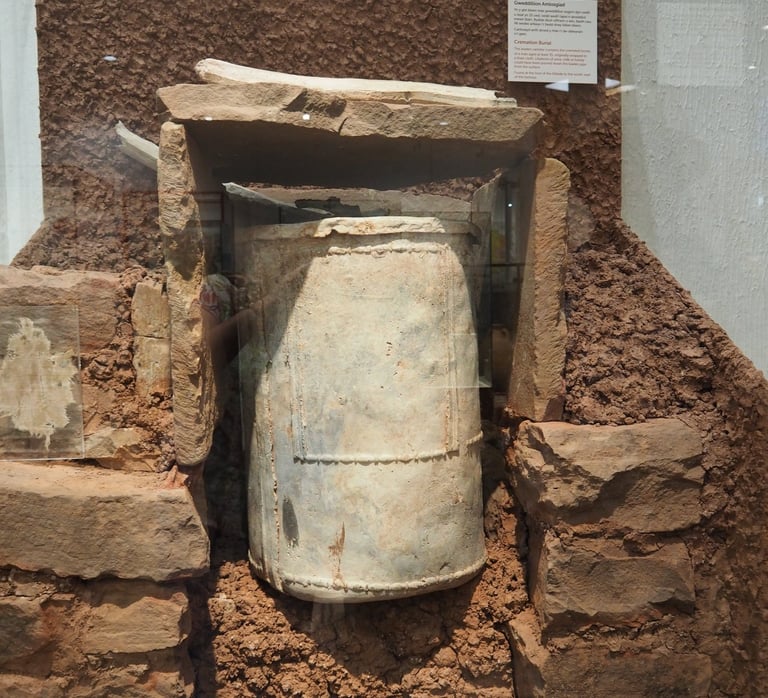
The cremations can be isolated, or in cemeteries, or below barrows. Cremated bones may be placed in pots, glass vessels or wooden caskets with metal fittings. A barrow at Rougham, Suffolk (2nd century AD), contained a cremation burial in a glass vessel accompanied by two sets of drinking and eating vessels, suggesting a double burial.
A group of barrows at Bartlow Hills on the Cambridgeshire-Essex border contained large wooden chests with iron fittings which held cremated bone, vessels of bronze, glass and pottery, and lamps which were left burning at the time of deposition. Anaerobic conditions preserved some organic materials such as a wreath, flower petals, incense and possibly wine and honey.
During this period there are no personal items like weapons or tools and very little jewellery, unlike earlier and later graves. Sometimes cremated bone was not in pottery vessels, although perishable containers were probably used.
Roman burial practices
The Romans, although bringing wide ranging changes to Britain, were often prepared to adopt many existing customs of native cultures and adapt them to their own needs. It is likely that much of British ritual life was unchanged in the early years of the Roman occupation, despite the historically attested crushing of the druids. The continuation of burial practices reflects this. Later, changes within the Roman Empire itself, such as the increasingly widespread adoption of Christianity, brought changes to the colonies. Burial practices in this period are characterized by cremation in the early period, and a return to large inhumation cemeteries later on.
Later Roman (1700–1500 years ago)
Large burial mounds continued to be built, covering both cremation and inhumation burials. A later barrow at Rougham contained an inhumation in a lead coffin placed inside a tile-lined structure.
Both pagan and Christian burials in this period were inhumations.
Pagan burials continue to have grave goods of a similar type to the earlier cremations - drinking and eating vessels, sometimes personal ornaments and dress accessories, coins in the mouth or on the eyes, and hobnail boots on the feet. Pagan cemeteries often include unusual burials. Most late Roman inhumations are extended on their backs (supine), but occasionally some are found in a prone (face down) position, or on their side. Decapitation with the head placed at the feet is another relatively common finding. Complete burials without a body are sometimes found in cemeteries, and these were probably cenotaphs to the memory of a lost individual. Tombstones mentioning such events are known. Status is interpreted from the wealth displayed in the grave goods, and from accompanying structures such as enclosing gullies around a grave or internal steps inside the grave pit.
Rural settlements, such as Lakenheath, have scattered inhumations along or in boundary ditches.
At Icklingham in Suffolk, a good example of a 4th-century Christian cemetery has been excavated. Burials were oriented east-west with the head at the west end, and there was a central building which was probably a church. A lead christening tank was found; this had a chi-rho symbol (XP - the Greek letters making up the first letters of 'Christos') on it.
Late Roman burials are often in stone or lead-lined coffins, and sometimes these are filled with gypsum or plaster. An example of this was found at Long Melford, Suffolk.
Roman law prevented burial within settlements, so cemeteries are located along the major routes out of large towns and along smaller roads at rural sites. Occasionally burials are found in settlements, but often these seem to have been the result of foul play. One exception is the burial of infants, which appears to have been a common occurrence, particularly in villa sites and small towns where they are often found under thresholds and in corners of rooms.
Early Anglo-Saxon (1500–1350 years ago)
Anglo-Saxon settlers signalled a change back to paganism for the next few centuries in Britain. They had their own well-established culture and had no need for the trappings of Roman life. They lived in wooden buildings grouped together in small settlements, generally with wider contacts throughout a region.
Early Anglo-Saxon burial rites include both large cremation and inhumation cemeteries, generally with copious grave goods at the beginning but with fewer towards the end of the period.
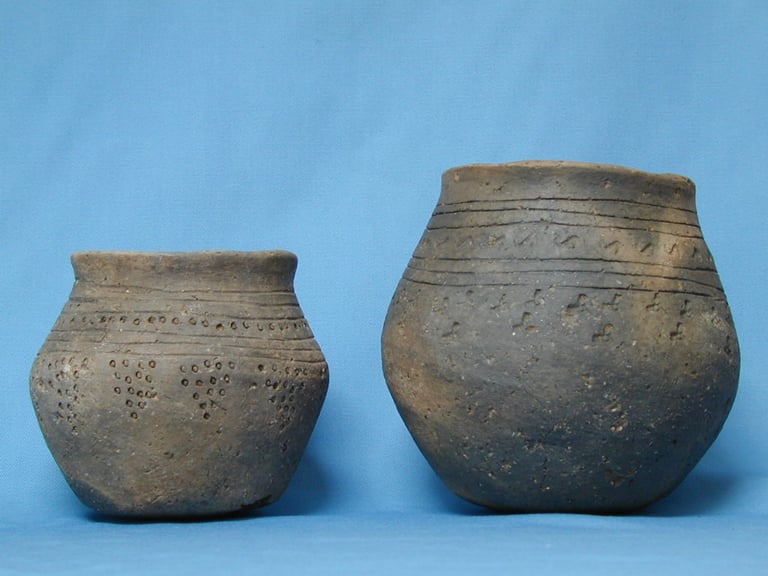
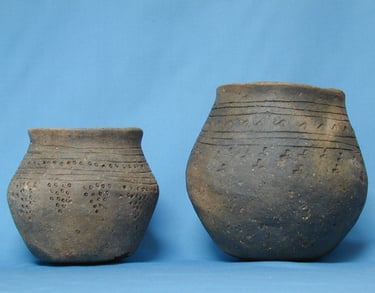
Cremation cemeteries were common in the first two centuries of Saxon settlement. Spong Hill was an enormous cemetery situated near North Elmham, Norfolk. Over 2300 cremation burials, most in pottery urns, were excavated and analysed. Some cremation burials contained fragments of burnt grave goods, for example melted glass beads, and others contained unburnt objects which were presumably added later. Extra fragments of bone from other individuals are sometimes included in the urns, perhaps fragments of friends or relatives, or just fragments already lying in the pyre area. Animal bone is also found, and may be part of a sacrificial offering.
Inhumation cemeteries (5th-7th c.) provide the major source of evidence for the period. Large numbers have been excavated and published. Various practices appears to be common, for example:
graves were sometimes too big and sometimes too small for the individual, suggesting that they were not custom dug.
most people were buried in unlined graves, but wooden or stone lining is relatively common; these were probably planks put into the grave before the body rather than coffins. They may have been covered by another plank, on top of which grave goods were sometimes placed, for example a spear and shield.
graves may have been marked with a low mound, a ring ditch, a post, or even a small wooden structure, although the evidence for this generally only survives in areas of chalk subsoil.
the body position was normally supine but sometimes flexed and rarely prone examples are found (some of the latter may have been live burials).
orientation of the grave is often west-east, but sometimes north-south.
dress fittings are commonly found and show that people were buried fully dressed. Generally women had two matching brooches at the shoulders, glass beads across the chest and a buckle at the waist. There are regional differences which reflect Anglian, Jutish and Saxon customs. Wrist clasps, for example, are an entirely Anglian phenomenon. Most women were also provided with a small knife at the waist.
weapons in graves include swords, spears, shields. The majority have only a spear, and not all male burials have weapons other than 'domestic' knives. Pagan priests were not allowed to carry weapons, so some of these burials may be of religious men.
sometimes charred wood or tree branches are found in the upper fills of graves.
High status burials are not common. Some very large wood-lined graves have been found, and there are occasionally burials in boats such as a canoe at Snape and the large clinker-built boat at Sutton Hoo. A few individuals appear to have been buried in beds, examples of which have been excavated at Swallowcliffe Down (Wiltshire), Barrington (Cambridgeshire) and Coddenham (Suffolk).
The basic rite of the Anglo-Saxons, whether cremated or inhumed, was probably very similar, with a fully clothed and equipped corpse being consigned either to the flames or to the earth.
Middle Saxon (1350-1150 years ago)
By this period Christianity had largely overcome pagan religion in England, and burials reflect this.
Examples of excavated Middle Saxon cemeteries include Caister-by-Yarmouth, Burgh Castle and Brandon. Smaller groups of this period have been found in Ipswich.
At Caister-by-Yarmouth only a small part of a much larger cemetery was excavated. The grave orientation was west-east with heads to the west. Several burials with clench nails (early 8th-early 9th century), possibly reusing lapped planks as lids were found, with increasing use of coffins in the same period followed by a decline afterwards. Some parts of the cemetery were waterlogged and preserved pegged oak coffins were found. Flexed burials were an entirely 8th century phenomenon. Some burials had stone packing around the head and/or feet, and this trait has been found in other Middle and Late Saxon cemeteries. Infant burials rare at this site, but this could be due to the nature of the excavation. The sex ratio was roughly 50:50 in adults. No sexual division in type of burial was seen. The site is possibly identified with the monastic site of Cnobheresburg.
On the outskirts of Ipswich, a small cemetery on the edge of a Mid-Late Saxon settlement or farmstead was recently excavated. This contained only twelve individuals, including adults and children. The bones showed no evidence for family relationships, but despite this, the cemetery was probably a small family burial ground away from the main centre of the Middle Saxon town.
Changes in burial customs may not be directly related to Christian beliefs - there are no decrees on the method of burial from this time. Wealth which was previously placed in the grave may instead have been given to the church. East-west burial was common in pre-Christian cemeteries and may simply have been adopted because it was the same as the orientation of the church. The rationale behind it - facing Christ at the Last Judgement - may be a later tradition.
Early medieval burial practices
The early medieval period in Britain varies across the country, depending on the presence or absence of Anglo-Saxon and, later, Scandinavian incomers. The text below applies mainly to the south and east of England.
Late Saxon and Anglo-Scandinavian (1150-800 years ago)
This period is a transitional one between essentially Saxon traditions and the changes brought first by the Scandinavian invaders and settlers, and later by the Norman hierarchy. In England generally, there was renewed growth of urban centres on a scale which had only previously been achieved by the Romans. Fortified towns were built both by the Saxons and the settling Vikings, a local example of which is the Danish settlement at Thetford.
Some Scandinavian settlers appear to have continued with their pagan burial traditions, but in general burial practices were largely Christian and by this period most people were buried in cemeteries associated with minster and parish churches. There was an increase in monastic foundations, and some lay people began to seek burial within these holy places.
Several secular cemeteries of this date have been excavated. In the south-west of England, cist grave cemeteries continued, but by the 9th century over most of England, burial in a churchyard was the norm. For example, at Raunds, Northamptonshire, a 10th-11th-century graveyard was excavated. All graves were aligned east-west with heads to the west, and there were no grave goods. Most were in simple earth graves, but some had slabs of limestone at the head or feet, a few had wooden coffins, and six had lidded stone coffins.
Excavations at monastic sites of this period include Jarrow, Monkwearmouth, and Hartlepool. Some notable differences from contemporary secular cemeteries have been found, particularly with regard to grave goods. For example, St. Cuthbert was buried with his full robes and many precious religious objects. Saxon Cathedral churches, e.g. North Elmham, also had cemeteries. Charcoal burials are known from several Cathedrals (York, Exeter, Hereford, Worcester, Oxford). The inclusion of ashes may have had a practical purpose, perhaps to soak up unpleasant smells, or possibly its presence was thought to preserve the body. At Hereford all the burials inside the church contained charcoal.
Anglo-Scandinavian burials are very rare. In Scandinavia, there was a revival of paganism in c.900 AD, the main burial rite consisting of inhumation or cremation with possessions in coffins, burial chambers or ships. Not many have been found in Britain, except in Norse areas such as the Isle of Man (over 40 known Viking burials), Cumbria and the Northern islands of Scotland. For example, a 9th c. boat grave at Westness, Rousay, Orkney, contained a man buried with sword, spear, axe, arrows and shield, adze, honestone, strike-a-light and flints. In these areas, prominent mounds overlooking the sea or possibly asserting claims to land are a common feature. Burial was in a very similar in form to Early Saxon graves, but with clearly Scandinavian grave goods. Objects which have been broken (ritually killed) are also found.
Other known Anglo-Scandinavian graves include a possible burial ground of the Mercian royal family at Repton, which includes mass burial around a mausoleum and several graves accompanied by Viking grave goods. At Ingleby, Derbyshire, a mound cemetery of c.60 barrows on a natural ridge overlooking the Trent contained cremation burials with grave goods. Other examples are known from Saffron Walden and Waltham Abbey in Essex.
By the late 10th to early 11th centuries, the Viking homelands were converted to Christianity. Viking artefacts, including weapons, have been found in Christian graveyards, so the Vikings may have been using existing burial places without necessarily being converted. Twelve of the York Minster burials, including two children, had carved stone slabs decorated in the Scandinavian style. A number of early 10th c. burials with grave goods were found in Carlisle Cathedral. Small groups of clench nails from planks are common finds in Viking graves, and it may be that those from Caister-by-Yarmouth (see above) are also from this period.
The general lack of Viking graves in the Danelaw area suggests assimilation into the native culture. Continuance in the Norse areas (Man, Cumbria) suggests assertion of dominance over the local populace.
At the Norman Conquest (1066 onwards), clearance of large areas of towns for building of castles often involved covering Saxon graveyards and demolition of churches. The Farmer's Avenue cemetery in Norwich was partially disturbed by the Castle ditches. At Blackgate, Newcastle, a cemetery was partially buried beneath the castle motte. At Raunds, a new church was built and there was clearance of the cemetery, including smashing of stone coffins and memorials, and reburial of bodies in charnel pits.
Medieval (800–500 years ago)
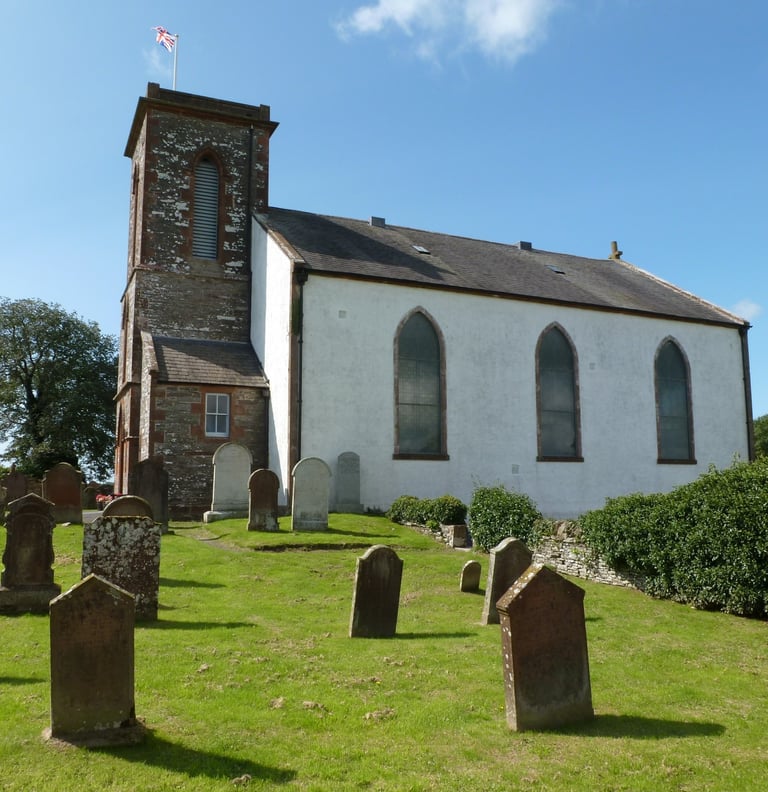
In the high medieval period the majority of people followed the normal Christian rites of no grave goods and simple east-west burials. Most people were buried in their own parish, but high status individuals could request burial at a monastic site, especially if they or their family were founders or benefactors. A few dress accessories have been found, but generally these relate to fastening of shrouds.
However, members of the Christian hierarchy were often buried with elaborate grave goods. Priest burials were accompanied by a pewter chalice and paten. Bishops and archbishops were often buried in full ceremonial robes. Some pilgrims wore their badges, e.g. cockle shells representing St. James. Both monks and laity were sometimes buried in cowls or habits - a burial in a black habit or shroud was found at the Cluniac Priory of St. Mary in Thetford. A few Royal burials have been studied, e.g. Edward I's tomb was opened in 1771 and found to contain the king in his royal robes with crown and sceptre.
Lime and chalk burials are known from York, Norwich, and London, but these are rare. Other inclusions in graves include organic remains such as hay, moss and flowers.
Papal bulls are also sometimes buried with bodies. Elsewhere in Europe, people were often buried with objects of their trade or status, but this does not appear to occur in England.
In the 12th century there was a change in belief from the Day of Judgement to Purgatory, and this seems to have affected the way in which bodies were treated. There tends to be less respect for older graves in the later medieval period, although this could also have occurred due to the demand for space and the lack of any grave markers. At Whithorn, the lack of space was compensated for by several reorganisations of the churchyard, with levelling occurring perhaps once every 20-30 years.
The practice of taking bones of saints as relics, or the burial of internal organs in separate places from the body is well documented.
Other types of burial in the medieval period:
Plague cemeteries especially in 14th century London, and possibly in Norwich.
Criminal burials - e.g. St. Margaret in Combusto, Norwich, where people were buried fully clothed in communal pits.
Jewish cemeteries - ten in England. Partial excavation has been carried out in London and Winchester, and the large cemetery of Jewbury in York was recently excavated. The latter was the burial place for Jews of York, Lincoln and Stamford. There is no intercutting of graves because of the Jewish belief of literal resurrection from the grave. Some clustering of burials by sex was observed, and children were not found in the excavated area. A comparison with people in Christian cemeteries in York suggested little ethnic difference, other than some minor differences in the back of the skull and the maxilla, and high frequencies of some genetic traits suggestive of a closed community.
Lepers were often buried in the grounds of leprosaria, but recent work in Norwich has shown that some were also buried in parish churchyards (Timberhill and Magdalen Street).
Medieval and later burial practices
Post-medieval
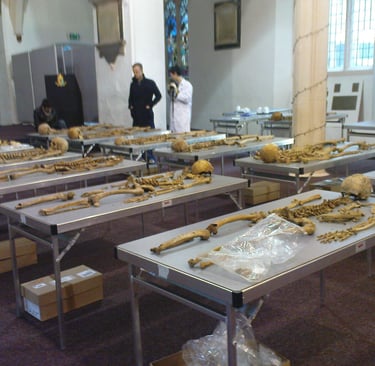
The period from the beginning of the 16th century has been identified as the start of the modern era and is termed post-medieval by archaeologists. Historians date this change from the reign of Henry VII and his innovations in government. Most of the evidence for this period is historical rather than archaeological, but a few excavations have been carried out in post-medieval churches, notably in London (St. Bride's and Christchurch, Spitalfields) and Holland (Zwolle). Other archaeological methods have been used to record standing monuments in churchyards and other funerary objects.
Spitalfields
burial in coffins within crypts, often stacked in precarious positions, sometimes even on their heads
excavated to recover a group of identifiable burials archaeologically for anthropological study.
also provided an insight into 18th and 19th c. crypt burial customs, and a closely dated series of funerary artefacts.
allowed for comparison of historical and archaeological data
e.g. accounts of contemporary funerals compared with the total disarray of coffins and bodies within the crypts.
Churchyard studies
e.g. Deetz and Dethlefsen looked at the 17th–18th-century changes in gravestones in New England: change from winged skull to cherub to willow and urn
this is a classic study in material culture, which allowed the changes to be traced across an area and individual masons to be identified
the change away from images of death to more classical icons was not just a changing fashion, but also signifies a growing unease with the whole process of physical decay which is still part of western culture today.
Legal aspects of burial archaeology
A few of the main points which apply in English Law:
there is no property in a corpse, so it cannot be stolen;
it is a common law offence to disinter a body without lawful authority;
it is an offence in ecclesiastical law to remove the remains of the dead from consecrated ground without a faculty.
Section 25 of the Burial Act of 1857 applies to most cases of exhumation.
this states that, with certain exceptions, 'it shall not be lawful to remove any body, or the remains of any body, which may have been interred in any place of burial, without licence' and without following any conditions prescribed in the licence.
licences are obtained by writing to the Ministry of Justice and supplying requested details.
if bones are removed without licence, the offence is committed by the person who actually removes the remains, and a fine may be charged for each and every body.
no offence is committed where a body is removed from one consecrated ground to another under faculty (an authority granted under ecclesiastical law).
a faculty is nearly always required for the exhumation of human remains from a place of burial which is within the jurisdiction of the Church of England.
a faculty is obtained through the Consistory Court by petition, and notice of the petition will normally have to be displayed in an appropriate public place beforehand.
The Disused Burial Grounds (Amendment) Act 1981 and the Pastoral Measure 1983.
the development of a disused burial ground is restricted by the Disused Burial Grounds Act 1884.
definition of a disused burial ground - 'any churchyard, cemetery or other ground, whether consecrated or not, which has at any time been set apart for the purpose of interment, and which is no longer used for interments'.
this does not include intramural burials within a church building.
the 1983 measure defines a burial ground as 'any land set apart and consecrated for the purpose of burials whether or not burials have taken place therein'.
the 1981 Act and the 1983 Measure regulate the removal of human remains and tombstones or memorials which may be affected by the development (the former to non-Church of England, the latter to Church of England burial grounds.
other burial grounds are covered by the original 1884 Act, but development is generally not prohibited if no one has been buried on the land in the last 50 years.
notice of the proposed development must be given by the landowner in local newspapers and at the site.
The Faculty Jurisdiction Measure 1964
tombstones and other memorials belong to the person who erected them, and after his death to the heirs of the person in whose memory the monument was erected.
grave goods - generally these belong to the landowner, but in post-medieval or early modern burial sites there may be claims to the effects from the personal representatives or relatives of the deceased.
Notes taken from Garratt-Frost 1992. Some aspects of this may have changed since then and you are advised to check legal requirements yourself.
Non-intrusive techniques
Churchyard surveys
This is something that anyone can carry out given a little time and a suitable local churchyard, particularly if it is threatened with redundancy or development.
gravestones and tombs can be seen as the latest archaeological layer of a churchyard, and should be recorded in detail (position, inscriptions, decoration, etc.) if the archive of data is to be of use in the future.
can be a starting point for genealogical, art historical and social history studies, or even a useful project for older school children, local history groups, etc.
a plan of the graveyard is a necessity and should be made before recording starts. Graves can then be assigned numbers which can be located on the plan.
stones should be recorded photographically and on a proforma (e.g. Jones 1984).
analysis of results and publication in a local journal or, at the very least, deposition of the archive at the local record office should be the final goal.
Aerial photography
useful in locating earlier forms of funerary monument, although flat cemeteries rarely show up with this technique.
aerial photography has been particularly useful over the last few dry summers in locating unknown barrow sites.
Fieldwalking
unlikely specifically to identify areas of burial, although controlled metal detecting has revealed plough-disturbed pagan Saxon cemeteries.
ploughed-out barrows may produce some evidence in the plough soil, particularly worked flints and occasional prehistoric pottery, but interpretation would probably be aided by aerial photography.
Ground-penetrating radar
this method has proved successful in locating individual burials.
it uses electro-magnetic pulses which are reflected back by soil surfaces that differ in water content.
produces a two-dimensional plot showing reflection delay time against horizontal distance.
burials in simple stratigraphy can be identified from the contrast between the fill and surrounding soil.
the technique works best on sandy, high-resistivity soils.
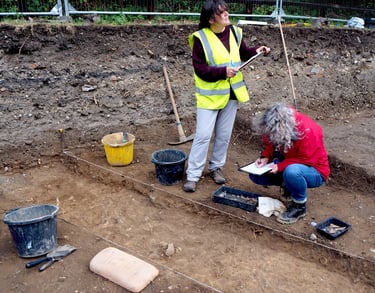
Excavation techniques
Rural cemeteries
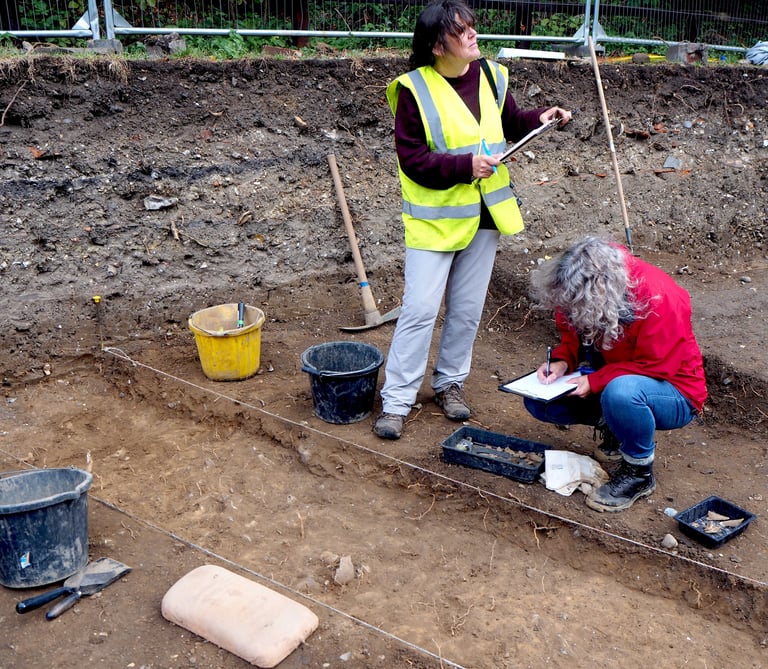
evaluation by trenching
removal of topsoil by machine
open area excavation
cleaning of site
visibility of grave fill against natural subsoil
excavation of individual graves including grave goods
recording: levels, context sheets, plans and grave profiles, overall grave plan with other non-cemetery features.
Other types of site may be more complicated
e.g. urban graveyards - intercutting graves and deep stratigraphy, but these allow for a greater possibility of phasing sequences of graves.
barrow cemetery - main methods of excavating are quarter sections of mounds, or sections of the surrounding ditch if this is all that survives, with excavation of central and other burial pits.
Post-excavation techniques
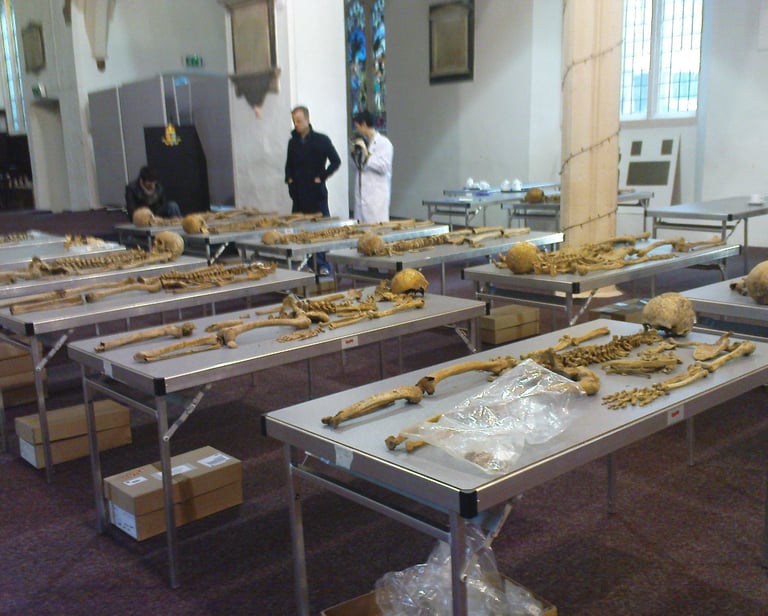
Analysis of cemeteries involves three major areas of analysis: graves and associated structures, grave goods, and human remains (for information on the latter, see Human Bone Homepage).
Analysis of graves and associated structures involves:
study of grave shapes and sizes in relation to the burial - too large or small?
depth, fill, profile of grave cut
cataloguing and interpretation of burial position and associated grave goods
cataloguing any structures such as mounds or postholes
making a Harris matrix of relationships between burials and other features
looking at types and positions of grave goods
using the demographic information provided by the bone specialist to reconstruct the burial population
phasing of the cemetery, based on all information (dated artefacts, orientation, position in the cemetery, body position, depth, relationships with other features and burials etc.)
production of publication drawings and text
long process, especially for large cemeteries, as the same aspects have to be covered for every grave - lots of computer work to look for patterns
for most sites, we go through several stages: preparation of archive, assessment of potential for further analysis, actual analysis and final report
Analysis of grave goods involves some or all of the following:
conservation stage - x-rays of metal objects and stabilisation if required
detailed catalogue of all objects by grave or by type/function, including finding parallels from other sites, and dating
record drawings of all objects, and publication drawings of some
employing specialists for various artefact types
scientific analysis - e.g. metallographic study of weapons to determine how made
analysis of samples taken from the graves or bodies - pollen, macrofossils
Archaeological techniques
Preservation and taphonomic studies
Taphonomy is the study of site formation processes (how an archaeological site is formed over time and the factors affecting this formation). The following is a summary of some aspects of this study in relation to burial archaeology. The factors listed below all have a bearing on the preservation of the archaeological deposit, its excavation and its interpretation.
Factors affecting method of burial
Cultural
religious beliefs and practices - use of skulls in rituals
tradition
manner of death - e.g. hanging
Economic and Political
cost of funeral
social status e.g. at Sutton Hoo
selection by others, e.g. Edward the Confessor's tomb
movement of people
availability of labour
Environmental
availability of suitable site - e.g. Saxon burial in floor of Fishbourne Roman Palace
space in graveyard
numbers of deaths occurring in a period
soil type - easy to dig a deep grave?
weather and season - e.g. winter weather causes problems, eg permafrost
time - how quickly does burial have/need to occur
disease
Familial
relationship with deceased - close family, extended family, no relation
need to be buried close to relatives or partners
religious rules - burial of monks away from genetic family
Factors affecting preservation
Biological
body shape and size
age at death
bone size, shape and density
Physical and Environmental
depth of burial
burial environment: water, soil type, temperature, oxygen
chalk, excellent for bone
sand and gravel very acid so poor for bone but may preserve some organic material including body and wood stains
waterlogged conditions - bog bodies
external environment - climate, temperature
flora and fauna present in the grave
deep ploughing at a later date
Cultural
burial method - stone or wood coffin, plaster burial etc.
presence of grave goods
intentional preservation - embalming, mummification
intentionally increasing speed of decay
exposure and excarnation prior to burial
time before burial
disturbance by later burials and effect this has on decay, disarticulation, reburial
Archaeological
time since burial
methods of excavation
processing and storage
Factors affecting cremated individuals
degree of burning
degree of crushing
collection (both after cremation and during excavation)
choice of scattering or burial
burial in the ground or in a container - perishable or non-perishable?
Sample variation
how much of the original cemetery population remains?
how much is excavated?
excavation does not normally produce a random sample
The interpretation of cemeteries and associated structures
Summary
The aims of cemetery analysis are to:
determine the sequence of development of the burial ground
estimate of size of community in each generation of use
reconstruct social status
The methods generally used are to:
compare grave orientations
analyse body positions
study demographical information from human bone
compare assemblages of grave goods
look for patterns in the spatial distribution of all of these aspects
Other methods and approaches are used for specific types of cemetery or burial:
scattered disarticulated bones can sometimes be matched to their pair or to an adjoining bone to look at movement of bones within Neolithic long barrows - e.g. Hazelton
when dealing with early prehistory we can, with care, use ethnographic parallels when trying to explain the lack of bodies - e.g. excarnation practiced by some native Americans, or sky burial in Tibet.
For the wider view of people in the past, we can look at various aspects through time:
e.g. social status - large tombs in the early Neolithic were probably for community use, although inclusion in them may indicate some 'special' status.
compare this with the individual wealthy burials of the Bronze Age
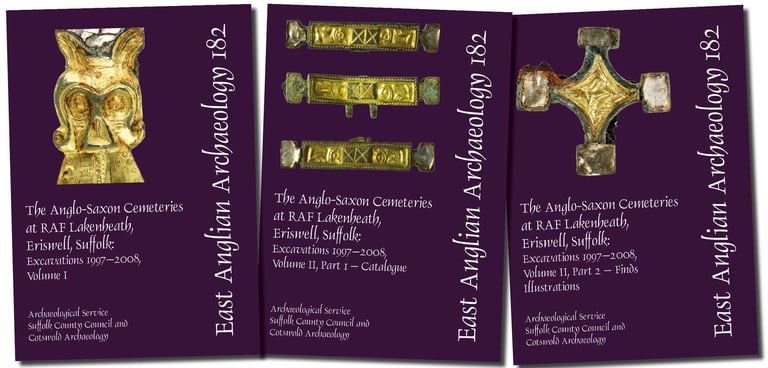
grave goods with individual burials in later periods seem to reflect a growth in material wealth amongst small groups of elite individuals - e.g. Sutton Hoo helmet and sceptre.
ritual practices such as decapitation seem to have been used at some periods but were not always popular.
clustering of burials in apparently ritual landscapes (e.g. around Stonehenge) may not be the full picture - have to consider changes to the landscape brought about by farming and other land use.
Interpretation and Conclusions
Conclusions
In interpreting death and burial in the past, there are certain factors which we need to consider:
present day attitudes to death - how do these affect our interpretations?
the relationship of burial with ritual/religion and everyday life
how does everyday life affect the choices made for disposal of the body
how much did people in the past choose their own funerary rites and how much was determined by relatives, tribal chiefs, religious leaders, etc. - and what impact does this have on our interpretation of an individual's personal status?
human behaviour is often erratic
we have to accept that there are some things which we will never fully understand.
further reading
General/ritual
Anderson, S. and Boyle, K., 1996, Ritual Treatment of Human and Animal Remains. Oxbow.
Bassett, S. (ed.), 1992, Death in Towns: urban responses to the dying and the dead, 100-1600. Leicester University Press.
Merrifield, R., 1987, The Archaeology of Ritual and Magic. Batsford, London.
Parker Pearson, M., 1999, The Archaeology of Death and Burial. Sutton.
Richards, J., 1999, Meet the Ancestors. BBC, London.
Period-based studies
Prehistory
Cunliffe, B., 1995, Iron Age Britain. English Heritage/Batsford, London.
Parker Pearson, M., 1993, Bronze Age Britain. English Heritage/Batsford, London.
Richards, J., 1991, Stonehenge. English Heritage/Batsford, London.
Stringer, C. and Gamble, C., 1993, In Search of the Neanderthals. London: Thames and Hudson.
Roman
Salway, P., 1981, Roman Britain. Oxford University Press.
Woodward, A., 1992, Shrines and Sacrifice. English Heritage/Batsford, London.
Saxon and Viking
Hall, R., 1990, Viking Age Archaeology in Britain and Ireland. Shire Publications, Aylesbury.
Richards, J., 1991, Viking Age England. English Heritage/Batsford, London.
Welch, M., 1992, Anglo-Saxon England. English Heritage/Batsford, London.
Medieval and later
Cox, M., 1996, Life and Death in Spitalfields 1700-1850. CBA, York.
Daniell, C., 1997, Death and Burial in Medieval England. Routledge, London.
Rodwell, W., 1989, Church Archaeology. English Heritage/Batsford, London.
Legal Aspects
Garratt-Frost, S., 1992, The Law and Burial Archaeology. Technical Paper 11, Institute of Field Archaeologists, Birmingham.
Techniques
Barker, P., 1982, Techniques of Archaeological Excavation. Batsford, London. 2nd edition.
Brothwell, D., 1981, Digging Up Bones. British Museum (NH)/ Oxford University Press.
Chamberlain, A., 1994, Human Remains. British Museum Press, London.
Deetz, J. and Dethlefsen, E., 1967 'Death's head, cherub, urn and willow', Natural History 76, 29-37. (Also reprinted in Pearce, S. (ed.), 1994, Interpreting Objects and Collections, Routledge, London.)
Jones, J., 1984, How to record graveyards. CBA/Rescue, London.
Mays, S., 1998, The Archaeology of Human Bones. Routledge, London.
Reports
Meaney, A.L. and Hawkes, S.C., 1970, Two Anglo-Saxon Cemeteries at Winnall. Society for Medieval Archaeology Monograph Series No. 4, London.
Stroud, G. and Kemp. R., 1993, Cemeteries of St. Andrew, Fishergate. The Archaeology of York 12/2. York Archaeological Trust/CBA.
Wenham, L.P., 1968, The Romano-British Cemetery at Trentholme Drive, York. HMSO, London.
I am based in the fine cathedral city of Norwich, Norfolk, UK.
Tel. 0758 407 9428
Email: sue@spoilheap.co.uk